
Ideas for a better investment
Mortgage Note Buying & Selling Etiquette
Master mortgage note buying and selling etiquette — how to make offers, run due diligence, price deals, & close professionally on Paperstac or off-market.

26 min read

Knowing how to buy or sell a mortgage note is one skill. Knowing how to behave throughout a note transaction — what to say, when to say it, how to make an offer, how to handle due diligence without burning bridges — is what separates investors who build lasting deal flow from those who struggle to find their second deal. Whether you’re transacting through a structured marketplace like Paperstac or working directly with sellers and buyers off-market, professional etiquette is the currency that opens doors. This guide covers both situations: the standards that apply everywhere, and what each approach looks like in practice.
- The mortgage note market is deeply relationship-driven — your professional reputation directly impacts your access to quality deal flow, whether you transact on a platform or directly.
- On Paperstac, the offer and communication process is built into the platform — no separate LOI document is required. Off-platform and direct transactions require a written Letter of Intent to be taken seriously.
- Sellers are expected to provide a complete, accurate documentation package — including payment history, UPB statement, and chain of title — before due diligence begins.
- Standard due diligence periods run 14–30 days for residential notes; extending without a documented material reason signals bad faith.
- Offers grounded in yield calculations — not emotion or wishful thinking — are the ones that get responded to, negotiated, and closed.
- Clear, timestamped communication at every stage of a deal protects both parties and dramatically reduces disputes at or before closing.
What Is a Mortgage Note Transaction?
When a mortgage note changes hands, a transaction occurs between the current note holder (the seller) and an investor purchasing the right to receive future loan payments (the buyer). This is distinct from buying real estate — the buyer acquires the income stream and the secured interest in the collateral property, not the property itself.
Who Are the Parties in a Note Transaction?
- Note Seller (Current Holder): The party transferring the right to collect future loan payments — may be a bank, private lender, fund, or individual investor.
- Note Buyer (Investor): The party acquiring the note, typically at a discount to the unpaid principal balance (UPB), in exchange for the right to the income stream.
- Mortgage Servicer: A third-party company that collects payments from the borrower and manages the loan on behalf of the note holder. Stays in place through ownership changes.
- Note Broker: An intermediary who connects buyers and sellers, typically earning a fee at closing. Confidentiality expectations are strict — circumventing a broker after an introduction is a serious professional violation.
- Title Company / Closing Attorney: Facilitates the legal transfer of ownership and ensures a clear, unbroken chain of title for the buyer.
Platform Transactions vs. Direct Deals: What’s the Difference?
Mortgage notes change hands through two primary channels — and while the core etiquette principles apply to both, the mechanics of how offers are made, documents are shared, and deals are managed differ significantly depending on which channel you’re using.
- Offers submitted through the built-in marketplace interface — no separate LOI document needed
- Note data entered as a structured listing — buyers can evaluate before initiating contact
- Communication is logged and timestamped inside the platform
- Document uploads are centralized — buyers access the package directly from the listing
- Platform creates a transparent, structured environment that reduces friction and miscommunication
- Verified participants on both sides of the transaction
- Written Letter of Intent (LOI) is the standard for formalizing an offer — verbal expressions of interest rarely hold
- Seller provides a note tape separately, usually via email or file share
- Communication happens via email or phone — maintaining a paper trail is the buyer’s and seller’s own responsibility
- Document requests and delivery are managed manually between parties
- Relationship and reputation serve as the primary trust signals — no platform verification layer
- Often accessed through networks, conferences, note brokers, or REIAs
Neither channel is inherently superior — experienced note investors use both, often simultaneously. What matters is that your behavior within each channel matches its norms. Treating a Paperstac listing like an off-market deal (expecting the seller to send documents outside the platform, submitting a separate LOI) creates unnecessary friction. Treating a direct seller relationship like a platform transaction (expecting built-in structure that isn’t there) creates confusion and missed steps.
Buyer Etiquette: How to Make Offers, Negotiate, and Navigate Due Diligence
How to Research Before You Reach Out
Whether you found the note on Paperstac or through a direct connection, preliminary underwriting before contact is non-negotiable. Run yield calculations at the asking price, assess the Loan-to-Value ratio, review the payment history summary, and cross-reference the property’s general market. Reaching out with questions clearly answered in the available materials wastes the seller’s time and signals inexperience from the first message.
How to Make an Offer: Paperstac vs. Direct
| Step | On Paperstac | On Direct / Off-Platform |
|---|---|---|
| Initial expression of interest | Message the seller through the platform listing | Email or phone call — keep it professional and brief |
| Formal offer | Submit offer through the platform’s built-in offer tool — no separate LOI needed | Written Letter of Intent (LOI) sent via email — verbal offers are rarely honored |
| Offer terms | Purchase price, contingencies, and timeline entered through the platform fields | LOI must include price, DD period, contingencies, closing timeline, and earnest deposit terms |
| Counteroffer response | Respond through the platform within 24–48 hours, even to decline | Respond via email within 24–48 hours — silence damages your reputation |
| Communication record | Automatically logged and timestamped by the platform | Your responsibility — maintain a clean email thread; confirm key agreements in writing |
Pricing Your Offer Correctly
Offers should be grounded in yield calculations, not wishful thinking or gut feel. For performing notes, buyers typically target annual yields between 10% and 14%, adjusted for LTV, note seasoning, interest rate spread, and collateral quality. On Paperstac, you can see the asking price and note data directly in the listing — use that to run your numbers before submitting. In direct deals, ask for the note tape before making any offer. Submitting a number you can’t defend with math signals inexperience to every experienced seller and broker in the market.
What Should a Letter of Intent (LOI) Include? (Direct Deals)
For off-platform and direct transactions, a written LOI is the standard that separates serious buyers from casual inquiries. It should include:
- Proposed purchase price — stated as a dollar amount and as a percentage of the current UPB
- Due diligence period — typically 14–21 business days from the date complete documents are delivered
- Contingencies — clear title, verified payment history via servicer, satisfactory BPO or collateral evaluation
- Proposed closing timeline — typically 7–10 days following close of the DD period
- Earnest money deposit (if applicable) — typically 1–3% of the proposed purchase price
- Contact information and your expected response timeline
Due Diligence Best Practices
Treating due diligence as an open-ended fishing expedition — piecemeal requests spread across two weeks, vague asks, or extensions without cause — is one of the fastest ways to destroy a seller relationship. This applies whether documents are delivered inside a Paperstac deal room or via email in a direct transaction.
Seller Etiquette: Documentation, Pricing, and Handling Multiple Buyers
Setting Up Your Listing or Note Tape
- Enter all note data accurately into the listing fields — UPB, rate, payment history, lien position, property info
- Upload your full documentation package to the listing before going live — buyers expect to review docs as part of their evaluation
- Set a realistic asking price; the active marketplace gives you real-time feedback on how the market receives your pricing
- Respond to buyer inquiries promptly through the platform message system
- Keep listing information current — outdated UPB or payment history erodes buyer confidence
- Prepare a clean, accurate note tape spreadsheet before approaching any buyer — this is the foundation of your deal
- Organize your full documentation package before marketing the note — incomplete docs delay closings and frustrate buyers
- Price based on yield math, not your original investment or emotional attachment to the note
- Respond to all written offers within 24–48 hours — even to decline
- Confirm all verbal agreements in a follow-up email to create a documented record
What Documents Should Sellers Provide?
Whether you’re uploading to a Paperstac listing or sending a package directly, the documentation expectations are the same. Buyers need everything in the table below to underwrite the deal with confidence. Sellers who deliver a complete, organized package upfront close faster, attract more competitive offers, and build the reputation for being easy to transact with.
| Document | Why Buyers Need It | Preferred Format |
|---|---|---|
| Original Promissory Note | Legal evidence of the debt obligation; required for a valid assignment | Certified copy or scanned original PDF |
| Mortgage or Deed of Trust | Confirms the note is secured by the collateral property and establishes lien position | Recorded copy from the county recorder |
| 24-Month Payment History | Establishes borrower reliability and note performance classification | Servicer-generated statement or payment ledger |
| Current UPB Statement | Confirms outstanding balance; forms basis of all pricing negotiations | Servicer balance or payoff statement |
| Property Information | Supports collateral valuation — address, type, condition if known | MLS data, county records, or recent photos |
| Lien Position Confirmation | First vs. second lien is a critical risk distinction — must be verified, not assumed | Title search excerpt or recorded document |
| Chain of Title / Assignments | Every ownership transfer since origination; broken chains delay or kill closings | All recorded assignments in sequence |
| Insurance & Tax Status | Uninsured or tax-delinquent properties represent immediate collateral risk | Insurance declarations page, county tax records |
How to Handle Multiple Buyers Ethically
- Disclose competition transparently: If multiple buyers are evaluating your note, tell each of them. Playing parties against each other without disclosure is reputation-ending in a market this connected.
- Set a uniform deadline: Give all interested buyers the same deadline to submit their best and final offer — this creates a fair, structured process on both channels.
- Honor verbal acceptances: If you verbally accepted an offer and later received a higher bid, you are ethically obligated to honor your first acceptance. This is one of the most defining moments for a seller’s long-term reputation.
- Notify rejected parties promptly: Once you’ve selected a buyer, notify all other parties within 24 hours. A brief, respectful message preserves those relationships for future deals.
What Is the Mortgage Note Transaction Timeline?
Understanding the typical sequence of events helps both parties set realistic expectations, communicate proactively, and avoid the miscommunications that cause deals to fall through. The stages are consistent across both Paperstac and direct transactions — what differs is where the activity happens.
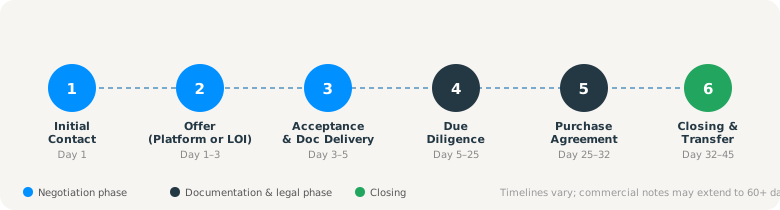
The stages where deals most commonly stall are between Step 3 and Step 4 — when incomplete document delivery delays the DD clock — and between Step 5 and Step 6, where contract negotiation friction over deal-level terms can drag on. Setting written deadlines at the start of each stage and communicating immediately when a deadline is at risk resolves the majority of deal fall-through situations before they become terminal.
Dos and Don’ts: Paperstac Platform vs. Direct Transactions
Some etiquette standards are universal — they apply whether you’re clicking through a Paperstac listing or exchanging emails with a direct seller. Others are channel-specific. The table below captures both.
| Situation | ✓ On Paperstac | ✓ Direct / Off-Platform | ✗ Avoid (Both Channels) |
|---|---|---|---|
| Making an offer | Use the platform’s offer tool with clear terms | Submit a written LOI with all material terms | Verbal offers with no follow-up documentation |
| Offer pricing | Review listing data; run yield math before submitting | Request the note tape; base offer on yield calculations | Lowball without a reasoned justification |
| Counteroffer response | Respond through the platform within 24–48 hrs | Reply via email within 24–48 hrs, even to decline | Go silent for days without explanation |
| Doc requests (buyer) | Review listing docs first; request missing items in one organized message | Send one complete, clearly labeled DD request upfront | Trickle requests across multiple weeks |
| Documentation (seller) | Upload complete package to the listing before going live | Prepare and share a complete note tape + doc package before marketing | Send incomplete materials and fill gaps reactively |
| Communication record | Platform logs everything automatically | Confirm all verbal agreements in writing via email | Rely on verbal memory alone for key deal terms |
| Multiple buyers | Disclose active offers or set a deadline for all parties | Disclose competition openly; set uniform deadline | Play parties against each other without disclosure |
| Pulling a deal | Communicate through the platform with a documented reason | Contact the seller promptly with a clear, written explanation | Ghost the counterparty without notice |
| Post-DD renegotiation | Renegotiate only if DD revealed a documented material discrepancy | Same standard — documented findings, not opportunistic chipping | Use the DD period as a stalling tactic to chip price without cause |
| Broker relationships | Honor platform terms; never attempt to circumvent through back-channel contact | Never go direct after an introduction through a broker | Circumventing a broker who made the introduction |
Red Flags to Watch For in Mortgage Note Transactions
Not every counterparty operates with equal professionalism or transparency — on any channel. Recognizing warning signs early protects your capital, your time, and your legal standing.
- Seller cannot produce the original promissory note or a complete, sequential chain of assignments
- Payment history is unavailable, self-reported, or not verifiable through a licensed servicer
- Seller resists a title search or discourages any form of third-party verification
- Unusual pressure to close quickly, bypassing a normal due diligence period
- Evasiveness about the reason for selling — especially on notes described as “performing”
- Material discrepancy between the stated UPB and the servicer-confirmed balance
- Seller is unwilling to execute a standard purchase and sale agreement
- On Paperstac: listing data is incomplete, inconsistent, or hasn’t been updated in a long time
- Buyer cannot demonstrate financial capacity to close when asked
- Repeated requests for timeline extensions with no specific, documented reason
- Attempts to renegotiate price repeatedly after initial acceptance without documented DD findings
- Aggressive, dismissive, or unprofessional communication style from first contact
- No verifiable track record of completed note purchases
- Any attempt to contact the borrower directly without explicit authorization
- On Paperstac: messages routed through the platform that try to push the deal to a private channel without cause
How Mortgage Note Pricing Works: Understanding Discount Ranges
One of the most common etiquette failures in note transactions stems from one or both parties misunderstanding how notes are actually priced. Notes rarely trade at par (face value). Discount equals the market’s pricing of time, risk, collateral quality, and opportunity cost. Performance status is the single most influential pricing variable in the private note market.
Typical Mortgage Note Discount Ranges by Performance Status (2026)
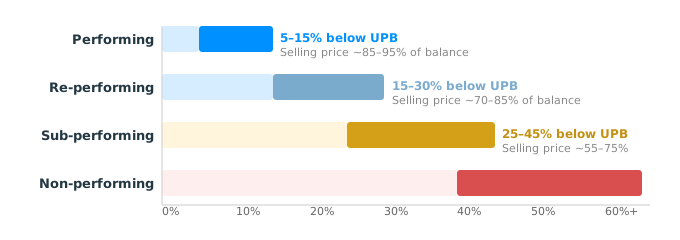
Source: American Association of Private Lenders (AAPL); Paperstac marketplace data; industry benchmarks. Ranges vary based on rate environment, collateral quality, LTV, geographic market, and note seasoning. © 2026 Paperstac.
What Industry Experts Say About Mortgage Note Etiquette
We reached out to active note investors, fund managers, and marketplace professionals across the industry and asked them the same questions. Their answers — drawn from hundreds of real transactions — cut through the theory and get straight to what actually matters in practice.
“Not doing what they say they will do. It’s that simple.”
“We’ve seen sellers continue to shop a deal or pull it after due diligence is complete. We had one seller who, after we got the asset under agreement and completed due diligence with no price fade, told us the borrower was going to pay it off in the next 45 days and they wanted to wait. Forty-five days went by, it didn’t close, they came back to us — and did it again. We wasted time and money on due diligence, and to me that is really poor etiquette.”
“The etiquette mistake I see most often is when sellers provide incomplete information upfront, then expect the buyer to hold their original pricing once new issues are discovered. In the note business, pricing is only as good as the facts provided. If a seller knows there are servicing issues, title concerns, borrower problems, or missing documents, the professional thing to do is disclose it early. A clean process doesn’t mean the file has to be perfect — it means everyone is honest about what is actually being sold.”
Justin Bogard is Co-Founder and President of American Note Buyers, where he buys and trades performing real estate notes and helps sellers, investors, and originators better understand how notes are valued, structured, and sold in the secondary market. American Note Buyers also manages a real estate debt fund that invests in mortgage notes, allowing investors to benefit from the cash flow generated by loans secured by real estate.
“I think the major etiquette mistake is one of relationship. Buyers and sellers need to establish a form of relationship for the transaction — relationship leads to trust, and building a relationship helps avert any issues after the closing of the deal.”
“A professional reminds the seller that we can close quickly. A professional also has the funds to purchase lined up in advance.”
“A professional note buyer spends the first few moments confirming whether the deal is real, actionable, and worth spending more time and money on. They’re not just chasing yield — they’re checking the collateral, borrower payment history, servicing records, lien position, unpaid balance, property value, taxes, and insurance. An amateur gets excited about the return. A professional starts looking for the risks that could make that return meaningless.”
“The first thing I do is a Google ‘drive by’ of the property — I look at Google Maps and drive by the property, down the block and around, looking for issues with the house, neighborhood, and area. Next I look at online resources to check the status of property taxes and any municipal code violation assessments. Then I look to the title chain to detect any breaks that would affect chain of title.”
“Yield is an outcome. Underwriting is the cause.”
— Justin Bogard, American Note Buyers“One of my biggest green flags when working with someone new is whether they’ve taken the time to understand the transaction before sending it out for review. The professionals usually provide a clear overview of the deal using a standard note worksheet, along with copies of the basic documents, a photo of the property, and the county tax assessor profile. Taking the time to organize it shows preparation, transparency, and respect for everyone’s time. It also tells me they’re not just ‘shopping paper’ blindly — they’ve started vetting the collateral, understanding the structure, and thinking like an investor.”
“Someone I know, like, and trust knows, likes, and trusts them.”
“My biggest green flag with someone new is organized, transparent communication. If they can provide the core documents, answer basic questions directly, admit what they don’t know, and avoid overselling the deal, that tells me they understand how this business works. I don’t need every seller or broker to have a perfect file — I need them to be straight with me, responsive, and realistic.”
“For me, it’s when a seller suddenly needs the deal closed ‘immediately’ and starts offering bigger discounts to make that happen. When someone starts saying things like ‘close by Friday and I’ll knock another $10,000 off,’ it raises concerns. Most note deals already move pretty fast — with most of the process waiting on documents and information from the seller anyway. Don’t let a seller rush your due diligence. We have a checklist, and we are not skipping anything on that list.”
“Not providing the necessary information to make a knowledgeable bid — and not providing that information in a timely manner.”
“If a seller goes dark or reneges on a verbal or written price agreement, that will kill the deal.”
“Going dark or fading the bid at the last minute. And dishonesty about the reason for selling.”
“The fastest way to lose a buyer is to make them feel like they’re discovering the truth instead of being told the truth. Buyers can underwrite risk — but they cannot underwrite surprises.”
“Not knowing what they are selling. If they can’t tell me about the file, why they are selling, and what their exit goals are, then I immediately become suspect and am careful not to commit.”
Where to Find Mortgage Notes for Sale
One of the most common questions from newer note investors is where quality deal flow actually comes from. Marketplaces and conferences are a starting point — but experienced investors build pipeline from a wider range of sources, many of which most people never think to approach. The sources below range from structured marketplaces to relationship-driven channels that can deliver off-market deals at favorable pricing.
Structured Marketplaces and Platforms
Note Marketplaces
Platforms like Paperstac list performing and non-performing residential notes from verified sellers. Structured listings include note data, payment history, and documents in one place — the most efficient starting point for buyers at any level.
Note Brokers
Licensed or experienced note brokers source and connect buyers with sellers, often with access to off-market deals and pool transactions not listed publicly. Working with a reputable broker can accelerate deal flow significantly — especially for larger volume buyers.
Note Investing Conferences
Events hosted by organizations like the American Association of Private Lenders (AAPL) and IMN draw active note sellers, funds, and servicers. Many deals are initiated in hallway conversations, not formal sessions.
Legal and Financial Professionals with Notes to Sell
Some of the most overlooked note sources sit inside professional networks that most investors never tap. These channels often produce motivated sellers — parties who need to convert notes to cash quickly — which can mean better pricing and fewer competing buyers.
Bankruptcy Attorneys
Chapter 7 and Chapter 11 bankruptcy cases frequently involve real property with attached mortgage notes that trustees are required to liquidate — sometimes quickly and at a discount. Building relationships with bankruptcy attorneys in your target market is a legitimate and underutilized pipeline strategy.
Estate & Probate Attorneys
Inherited mortgage notes are common and frequently undervalued by heirs who simply want liquidity rather than monthly payments. Probate attorneys regularly encounter clients holding notes on properties they’ve never seen — and many don’t know where to turn. Being the investor they call is a significant competitive advantage.
Mortgage Note Funds
Funds that hold pools of mortgage notes — like Labrador Lending’s Integrity Income Fund — occasionally sell individual notes to rebalance portfolios, free up capital for new acquisitions, or offload assets that no longer fit their investment criteria. Building relationships with fund managers can surface notes before they reach any marketplace.
Banks, Lenders, and Private Originators
Community Banks & Credit Unions
Smaller financial institutions periodically sell individual loans or small note pools rather than pursue the time and cost of foreclosure. They prefer quick, clean transactions with experienced buyers — making professional etiquette and a verifiable track record especially important when approaching them directly.
Hard Money & Private Lenders
Hard money lenders originate short-term real estate loans constantly and sometimes sell seasoned notes to redeploy capital into new originations. They’re often open to repeat buyer relationships — consistent, professional buyers who close on time get first access to new inventory.
Seller-Financed Note Holders
Individual homeowners who sold property using owner financing hold private mortgage notes — and many eventually want a lump sum rather than years of monthly payments. These sellers are often found through direct mail campaigns, referrals from real estate agents, or title companies familiar with owner-financed transactions in your target market.
Mortgage Note Transaction Glossary
- Allonge
- A document attached to a promissory note to record endorsements when there is no remaining space on the note itself. Used to formally transfer ownership through the chain of title.
- Assignment of Mortgage
- A recorded legal document that officially transfers ownership of a mortgage (or deed of trust) from one party to another. Every note sale requires a properly executed, recorded assignment to establish clean title for the new owner.
- BPO (Broker Price Opinion)
- An estimate of a property’s current market value prepared by a licensed real estate broker. Commonly used during note due diligence as a faster, lower-cost alternative to a full appraisal — particularly for performing note transactions.
- Chain of Title
- The documented sequence of ownership transfers for a mortgage note from origination through every subsequent assignment. A broken or missing link creates significant legal risk and can prevent a valid assignment from being completed.
- Data Tape / Note Tape
- A spreadsheet summarizing key data points of a note or pool of notes — UPB, interest rate, maturity date, payment history, property address, and lien position. The foundational document for any note transaction. On Paperstac, this data is entered directly into the listing.
- Letter of Intent (LOI)
- A non-binding written document in which a buyer formally signals interest in purchasing a note under defined terms. Standard practice for off-platform and direct note transactions. Not required on Paperstac, where the platform’s offer tool serves this function.
- Lien Position
- Describes where a mortgage ranks in the priority of claims against a property. First-lien notes have priority in foreclosure. Second-lien notes are subordinate and carry significantly higher risk — especially in declining property markets.
- Non-Performing Note (NPN)
- A mortgage note where the borrower has defaulted, typically 90+ days past due. NPNs require active resolution strategies — modification, short sale, or foreclosure — and trade at steep discounts to UPB. Not appropriate for passive income framing.
- Performing Note
- A mortgage note where the borrower is current on payments, typically fewer than 30 days past due. Performing notes generate predictable monthly income appropriate for investors seeking passive real estate cash flow.
- Re-performing Note (RPN)
- A previously non-performing note where the borrower has resumed regular payments, usually following a loan modification. Trades at an intermediate discount between performing and non-performing notes.
- Seasoning
- The length of consistent payment history on a note since origination or last modification. Notes with 12+ months of on-time payments are considered well-seasoned — a positive pricing signal that indicates borrower reliability.
- Unpaid Principal Balance (UPB)
- The outstanding loan amount owed by the borrower at any given point, excluding accrued interest or fees. The primary reference figure for calculating note purchase price as a percentage of face value.
Frequently Asked Questions
Do I need to submit a written LOI to buy a mortgage note on Paperstac?
No — on Paperstac, the offer process is built directly into the platform. Buyers submit offers through the marketplace interface, which captures the terms, timestamps communication, and documents the transaction automatically. A separate Letter of Intent document is not required. LOIs are the standard for direct, off-platform note transactions where no structured marketplace is facilitating the deal and there’s no built-in record of the offer terms.
What is proper etiquette when making an offer on a mortgage note off-platform?
For direct note transactions outside a marketplace, always submit a written Letter of Intent (LOI) specifying your proposed purchase price, due diligence period, contingencies, and closing timeline. Verbal offers are rarely honored and create no obligation for the seller to hold the note. Offers should be grounded in realistic yield calculations — performing notes typically target 10–14% annual returns — and you should respond to any counteroffer within 24–48 hours to demonstrate serious buying intent.
What documents should a seller provide when selling a mortgage note?
Sellers should provide the original promissory note, mortgage or deed of trust, 24 months of payment history from the servicer, a current UPB statement, property information, lien position confirmation, and a complete sequential chain of title assignments. On Paperstac, sellers upload these documents directly to the listing so buyers can review them as part of their evaluation before submitting an offer. In direct transactions, the seller delivers this package once an LOI is accepted and the due diligence period begins.
How long does due diligence take when buying a mortgage note?
Standard due diligence periods for residential mortgage notes run 14 to 30 days from the date complete documents are delivered. During this window, buyers verify all documentation, order a Broker Price Opinion (BPO), review the chain of title, and confirm payment history directly with the servicer. Commercial notes may require 30–60 days. Extending due diligence without a documented material reason is considered a professional breach on both Paperstac and in direct transactions.
Is it acceptable to make lowball offers on mortgage notes?
Offers far below what yield calculations support damage your reputation in a market where the same participants interact repeatedly over years. While negotiation is expected, offers should reflect realistic yield targets for the note type and risk profile. If you believe the asking price is high, submit a reasoned counteroffer with your yield analysis rather than an insulting number. This standard applies whether you’re making an offer through Paperstac or approaching a seller directly.
Can a seller back out after accepting an offer on a mortgage note?
Technically, a seller can withdraw before a formal purchase and sale agreement is signed, but doing so after acceptance — verbal or written — causes serious and lasting damage to professional relationships. Once a signed contract is in place, backing out may create legal liability for breach of contract. Note industry norms on both channels expect accepted offers to be honored in good faith, with both parties moving promptly to execute a written agreement after acceptance.
What is a note tape and why does it matter?
A note tape (or data tape) is a spreadsheet summarizing a mortgage note’s key data: unpaid principal balance, interest rate, maturity date, payment history, property address, lien position, and borrower information. It is the foundational document for any note transaction — buyers use it for initial underwriting and pricing. On Paperstac, this data is entered directly into the listing so it’s always structured and accessible. In direct deals, the seller provides it separately, typically early in the conversation.
How do I find reputable mortgage note buyers and sellers?
Mortgage notes are available through a wider range of sources than most newer investors realize. Structured marketplaces like Paperstac are the most accessible starting point — listings include standardized note data, payment history, and documents. Beyond marketplaces, experienced investors source deals from note brokers, industry conferences (AAPL, IMN), bankruptcy attorneys liquidating estate assets, probate and estate attorneys whose clients hold inherited notes, mortgage note funds rebalancing portfolios, community banks and credit unions selling individual loans, hard money lenders offloading seasoned paper, and seller-financed note holders seeking liquidity. Each channel has different pricing dynamics and etiquette expectations — but the consistent thread is that professional behavior, a verifiable track record, and prompt communication open doors in all of them. See our full breakdown in the Where to Find Mortgage Notes for Sale section above.
Ready to Buy or Sell a Mortgage Note?
Paperstac provides a transparent, structured marketplace where note transactions happen with standardized listings, organized documentation, and built-in offer tools — so both buyers and sellers can transact with confidence.
Explore Notes on Paperstac →Sources & References
- Mortgage Bankers Association. (2025). Secondary Mortgage Market Overview. mba.org
- American Association of Private Lenders. (2025). Private Lending Market Standards. aaplonline.com
- Consumer Financial Protection Bureau. (2024). Mortgage Servicing Rules Overview. consumerfinance.gov
- Paperstac. (2026). Mortgage Note Due Diligence Guide. paperstac.com/blog/mortgage-note-due-diligence/